Monday, 24 January 2022

Accelerate delivery, improve quality and reduce time-to-market

Traffic Parrot can help you with:

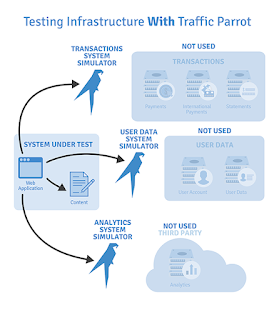
  • Unblocking testers and developers waiting for APIs (faster time to market)
  • Easier and faster to reproduce production bugs (faster time to market)
  • Speed up setting up test data (faster time to market, higher quality)
  • Eliminate the need for scheduling time on environments (faster time to market, higher quality)
  • Reduce third-party transaction costs (lower costs)
  • Make your performance tests more reliable (higher quality)
  • Allow to develop automated test sooner and run the builds run faster (faster time to market, higher quality)
Please, contact us for more details. Feel free to review our information on "Getting started with stubbing, mocking and service virtualization".


Friday, 7 January 2022

Traffic Parrot 5.30.1 released, what's new?

We have just released version 5.30.1. Here is a list of the changes that came with the release:

Features

  • Added support for connecting to an internal or external ActiveMQ broker via JMS AMQP 1.0
  • Added support for username/password when connecting to external ActiveMQ broker

Changes

  • Include ActiveMQ sample JMS AMQP 1.0 connection

Fixes

  • Fixed an issue with the {{ regex }} helper when using an {{ xPath }} result as a parameter
  • Library upgrades to fix OWASP issues

Tuesday, 4 January 2022

Three case studies on API-first Development and Consumer-Driven Contracts

At Traffic Parrot we have seen several companies embark on the API-first journey, a few of which also approach their API strategy consumer-first and implemented Consumer-Driven contracts.

In this short article, we summarise two categories of engagements we have seen faced by the teams:

  • Implementing API-first approach for teams that have not done API-first before and starting their journey with microservices (up to 5-20 microservices in production)

  • Implementing Consumer-Driven Contract Testing on teams that are already proficient in API-first development approach and face issues with large scale contract testing of microservices (more than 50-100 microservices in production)

Useful terms to know

  • API-first development: the move to microservices typically also drives an API-first development approach, where teams define upfront business contracts between each other using APIs. A sample API specification language: OpenAPI or Protobuf

  • Consumer-Driven Contracts: When you design an API, its syntax and semantics will be designed by the API producer team by working closely with the teams that will consume the API as opposed to the API producer team making assumptions based on the data model how the API should look like. The API consumer teams drive the shape of the APIs.

  • Consumer-Driven Contract Testing: A type of contract testing where we are ensuring in automated tests that the contracts designed in a consumer-driven fashion are met. This allows confidence that a new release of a microservice will not result in breaking API changes in production. A sample tool: Pact-JVM

High-level summary

It has been our clients’ experience that:

  1. The API-first approach is an effective way to parallelise work between teams working in fast-paced environments and microservice-based architectures.

  2. Allowing teams to work closely with each other and design APIs in a consumer-driven fashion helps drive quality and reduce time to market no matter the team size and deployment scale.

  3. Although consumer-driven testing is a well-grounded way of testing contracts it can be counterproductive to introduce it to teams that are not experienced in the API-first approach or run less than 5-20 microservices in production.


Case study: a large media company using an API-first approach and Consumer-driven testing 

A global media company had an existing stack of 100+ microservices that was primarily tested with automated BDD E2E tests. The releases were done every 2-4 weeks.

These tests were costly to maintain because it took significant developer time to write and debug the suite of tests. The suite of tests took 2 hours to run, and up to a week to investigate issues before every release.

Developers were often frustrated as the tests were flaky due to the complexity of the system under test, leading to many non-deterministic failure points. These tests would prevent them from releasing new features on-demand as the tests took a few hours to run. 

With this experience, the company decided to avoid E2E testing for the new product they were working on.

The main way they decided to grow confidence in the contracts between new microservices and the behaviour of the product as a whole was to design contracts in a consumer-driven way. The company chose consumer-driven contract testing with Pact-JVM to test those contracts. Most of the teams were entirely new to consumer-driven contracts. 

Equipped with a solid API-first design approach background across all teams, and several years of experience with automated BDD-style Acceptance and E2E testing, as well as TDD on unit-level they felt confident in learning the consumer-driven contract testing approach. Unfortunately, that proved not to be true after a few months of working on the problem. It was the teams’ experience that about a fifth of the developers did pick up the new workflow rapidly but the majority of the team had issues understanding the new workflow even after a few months of working on it and about a fifth of the team even after 12 months did not onboard themselves fully to the new process. 

There was a change to infrastructure happening at the same time, moving away from bare-metal to Kuberenetes and Docker deployments. 

The J-Curve Effect of this transformation was noticeable but manageable. Teams adopted just a few new tools and practices as part of this transformation (PactJVM, Docker, Kubernetes) and it was enough to keep developers and testers busy changing their daily habits. In retrospect, the investment in consumer-driven contract testing was justified but the ROI was not significant, close to breaking even. 

Case study: a global e-commerce giant using API-first approach

The company decided to move away from a monolithic architecture to more autonomous teams and microservices. As part of that transition, they decided to recommend good practices rather than force the use of specific technologies and solutions onto teams, trusting the teams to make the right judgements on which tools and techniques will make the most positive impact on their daily activities.

The developers wrote integration tests and used an API mocking tool Traffic Parrot to mock dependent components. They also wrote Cucumber/Gherkin BDD acceptance API tests to capture the business requirements (they called these "contract tests"), which use a Docker image of the microservice and a Docker image with the Traffic Parrot API mocks. The BDD tests verify both the microservice API and interactions with dependent components by verifying the interactions on the API mocks. That way, the BDD tests verify both microservice API request and response and all communication with dependent components by assertions and verifications.

The company decided to create the API mocks in two ways.

First, if the API that a developer wants to consume already exists, they create the API mocks by recording requests and responses. A developer starts by creating a new test on their computer. They then run the test and create API mocks by recording them. They commit the tests and mocks to the microservice project in Git. In a QA pipeline (a pipeline that is run per commit to checking the quality of the product), they start a Docker container that runs the API mocking tool and mounts the mock definitions from the microservice project.

Second, if the API the microservice will consume does not exist yet, a developer will create the API mocks from OpenAPI specifications for HTTP REST APIs or create the API mocks from protocol buffer specification files for gRPC APIs.

They also develop and run automated E2E smoke tests. This is one of the techniques to test contracts between microservices and it makes sure groups of microservices work well together. The presence of the E2E test suite is justified as it is tested not only the producer side of contracts, which is tested in the BDD tests, but also the consumer side, and so provides more confidence. The architects monitor the number of E2E tests. They keep the complexity of the E2E test suite at a level that does not cripple the release process or daily development activities.

The move to consumer-driven contract testing was not justified in the eyes of the architects and individual teams on an enterprise-scale as the J-Curve Effect impact would be too significant and the ROI not justifiable in a reasonable timeframe. Out of the hundreds of developers that work for the company, only a handful decided to use consumer-driven contract testing, as they were already very familiar with the API-first approach and had several years of experience in BDD.

Case study: an InsurTech startup using API-first approach

The company had a handful of teams working on a dozen of microservices. The microservices were replacing part of a deprecated monolith.  

The producer teams designed the APIs for the teams to consume. To manage contracts between teams and allow teams to work in parallel, they decided to use API mocks that the API producers created and shared with the API consumers. They created the gRPC API service mocks using an API mocking tool Traffic Parrot.

They also used a handful of manual E2E tests in a pre-production environment to make sure that the microservices would work together in the absence of sufficient automated testing. They would fill the gaps in automated testing on an ongoing basis, which took 12 months of ongoing part-time effort.

To make sure mocks do not get out of date, and to hit their aggressive deadlines, the company decided to test the API mocks by firing a request at both a mock and a real microservice. They compared both responses to a contract definition of expected request/response pairs as defined in a company-specific custom format. This way, the API mocks and the real service was proven to be up to date when compared to the latest definition of the expected behaviour defined in the contract file. This proved to be a good enough solution to remove the bottleneck of testing contacts and allow the teams to focus on delivering the features to customers.

The team contemplated using consumer-driven contact testing but at first glance, it seemed like they would be shooting a fly from a cannon and they have decided to stick to their original good-enough testing plan and revisit the issue in 12-24 months while keeping an eye on the complexity of the existing suite of tests so the maintenance costs do not become significant.

Next steps

At Traffic Parrot we would be happy to help you and your team provide feedback on your transformation strategy. Reach out to us to schedule a call where we walk around your requirements and provide early feedback. If your experience with Consumer-Driven Contract testing was different, please let us know in the comments below!

Friday, 31 December 2021

Traffic Parrot 5.29.7 released, what's new?

We have just released version 5.29.7. Here is a list of the changes that came with the release:

Features

  • Added new trafficparrot.properties to allow configuring separate HTTP and HTTPS ports for the UI:
    • trafficparrot.gui.http.port=8080
    • trafficparrot.gui.http.port.enabled=true
    • trafficparrot.gui.https.port=8079
    • trafficparrot.gui.https.port.enabled=true
    • trafficparrot.gui.https.jks.resource=certificates/user-interface-https.jks
    • trafficparrot.gui.https.jks.password=trafficparrot
  • Added support for connecting to an external RabbitMQ 3 broker via JMS
  • Added support for HTTP webhooks including:
    • UI to configure callback on the HTTP Add/Edit mapping page
    • Send request callback after a fixed delay
    • Use data from the original request and response body in the callback request template
    • Enable callback to be sent or not based on script
  • Added support for uploading data directory when uploading an HTTP mappings zip file
  • Added support for DOTALL option in {{ regexExtract }} helper

Changes

  • Upgraded WireMock from 2.29.1 to 2.31.0
    • WireMock removed support for parameter normalizing in response templates
    • To restore parameter normalizing behaviour, please set: trafficparrot.virtualservice.handlebars.normalizeHelperParameters=true
  • Upgraded gRPC from 1.39.0 to 1.43.1
  • Upgraded protoc from 3.17.3 to 3.19.1
  • Include RabbitMQ sample JMS connection

Fixes

  • Fixed a bug with indexed {{ dataSource }} parameters
  • Fixed a bug with mixed type XLS columns
  • Fixed a bug with the tray icon on Windows
  • Library upgrades to fix OWASP issues

Wednesday, 1 December 2021

Do you need an asynchronous API mocking tool, asynchronous API testing tool or both?

In most cases, companies reach out to us because they are looking for a tool with service virtualization or API mocking capabilities. There are, however, situations where it is unclear if that is the only use case they would like us to help them with, especially when it comes to asynchronous message processing like IBM MQ, ActiveMQ, or RabbitMQ.

To help us better understand your needs, please review the diagram below and let us know if you would like us to help you with the blue elements on the diagram, the green ones, or both?

Do you need an asynchronous API mocking tool, asynchronous API testing tool or both?


Thursday, 18 November 2021

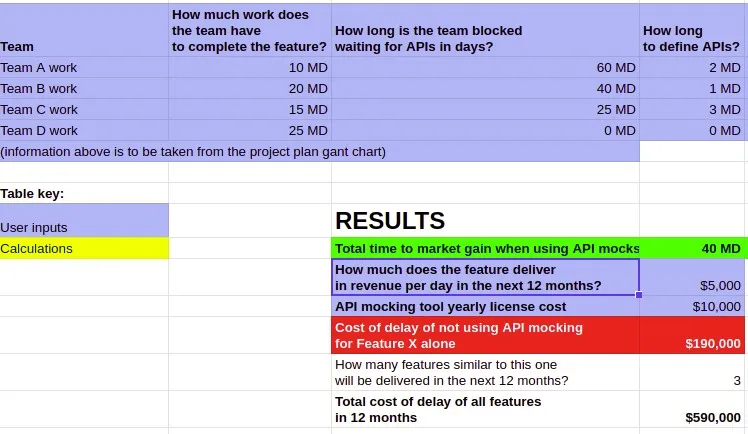
What is the cost of delay of not using API-first development and API mocks?

InfoQ has just published our latest article on “ Using API-First Development and API Mocking to Break Critical Path Dependencies ”.

Key takeaways:

  • Many organizations are moving towards API-first development in order to decrease the coupling between teams and increase development velocity. Using API mocks can support the goals of this initiative.

  • We present a case study on API-first development that used API mocks to enable teams to work in parallel and be faster to market

  • There is a simple way of estimating the value parallelizing teamwork using API mocks will bring to your organization, based on the cost of delay

  • The spreadsheet model provided in this article can be used to calculate potential savings 

  • Adoption of API mocking requires just one team -- there is no need to migrate the whole organization at once

If you would like to see a cost of delay calculation sheet specific to your circumstances, please reach out to us by replying to this email, filling in the contact form or calling +44 20 3239 7753. We offer models for different cases like slow CI/CD builds, unavailable third party dependencies and more. 


Wednesday, 17 November 2021

Pros and cons of running API mocks inside CI/CD

Our customers choose to run their mocks inside and also outside their CI/CD builds and pipelines. There are advantages and disadvantages to both approaches.

Typically, if the system under test is running (microservice under test) inside CI/CD then our customers would also run their API mocks inside CI/CD.

On the first diagram below, we show how running API mocks inside CI/CD would look like, on the second diagram we show how running outside CI/CD would look like. 

Pros of running inside CI/CD

  • Major: More resilient builds because they do not rely on any external components or infrastructure
  • Major: More resilient builds due to relying on known API mock state by using ephemeral per-test-run API mock instances with the test-primed state instead of long-running API mock instances with undefined state
  • Major: Easier to set up and maintain builds by running API mocking (service virtualization) tool from maven/Gradle before the tests and tear down after tests

Cons of running inside CI/CD

  • Critical: To run API mocks inside CI/CD the system under test needs to be capable of running inside CI/CD as well
  • Major: People need to be trained on how to use mocks inside CI/CD
  • Major: Need an API mocking (service virtualization) tool with a low footprint that is designed to be run per test or per build (i.e Wiremock, Mountebank or Traffic Parrot)
  • Major: Performance testing might need additional hardware resources to support 1000+ TPS (req/s)
  • Minor: Debugging builds with no access to a running API mock tool instance means the observability of the API mocking tool needs to be high - the logs need to contain enough information to   
  • Minor: additional hardware resources needed on the build agent/slave/runner


Wednesday, 20 October 2021

Thursday, 7 October 2021

Typical Kubernetes deployment setup for large scale Traffic Parrot virtual service and API mock installations

Traffic Parrot customers use Kubernetes and Docker to deploy virtual services in environments used by both QA and development teams.  

Below is a typical Kubernetes infrastructure for deploying applications using a structured build automation process.


Our customers typically use Ingress to expose the services outside of the cluster. 

We recommend doing blue-green rolling releases to maintain the uptime of the virtual services.

If you use JMS or IBM MQ you will need to reach out to the message broker that is hosted outside the cluster.

In this example, Splunk is used for the log aggregator. Flux is often used to maintain the cluster's state inside a Git repository and let that sync up itself using the tool. We don't recommend using kubectl commands or Rancher UI, or anything like that to make manual changes to the cluster.

Prometheus can be useful for health checking and making sure things are still up and running.  

Traffic Parrot stores its configuration in JSON configuration files. And those configuration files define which endpoints are supported for a particular pod and determine what kind of virtual services or API mocks it has. 

Delivery Pipeline

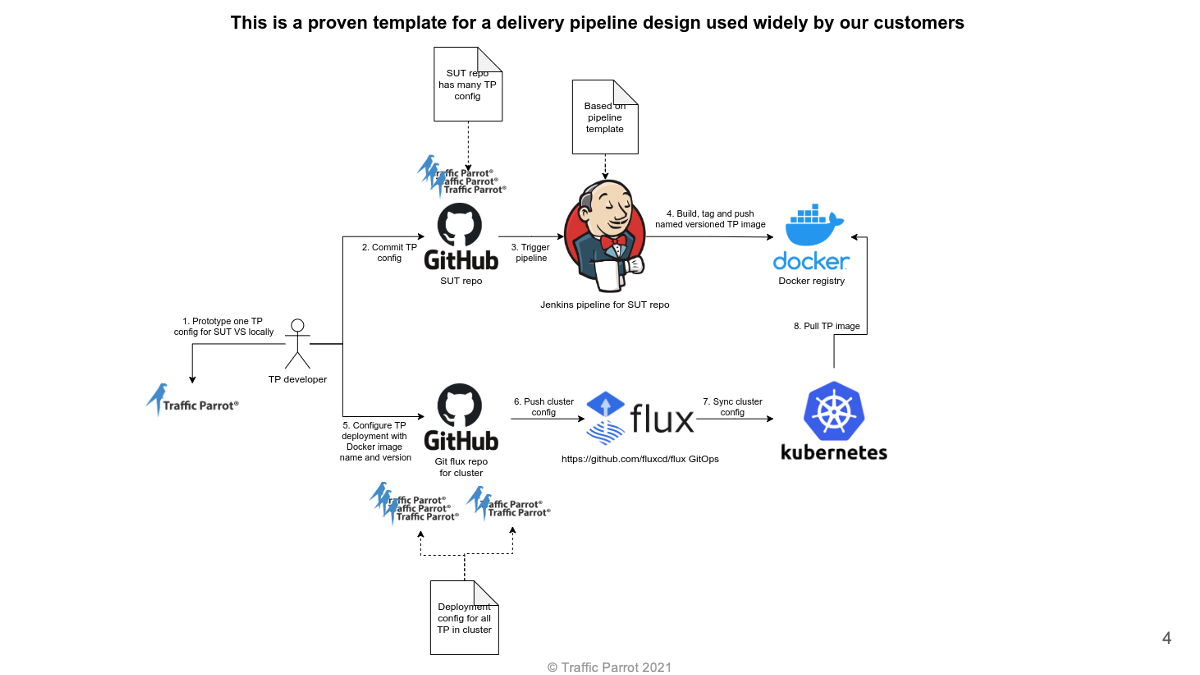
This diagram shows an approach for setting up a continuous delivery pipeline to deploy Traffic Parrot containers running API mocks and virtual services in Kubernetes. 


This is an example of a delivery pipeline with a separated deployment configuration from the virtual service configuration. The developers, once they've prototyped their virtual services locally, they'll commit the Traffic Parrot configuration to a system under test repo. 

In “2. commit TP config”, a Docker image with TP config files is built that can then be used inside the Kubernetes cluster. 

The SUT repo has many Traffic Parrot configs, and it's triggering a pipeline so one or more of those configs are then built into the image.

In “5. Commit TP Deployment” where Traffic Parrot is deployed with a Docker image name and version, the deployment configuration is held in a Git Flux repository and will be synced to the Kuberenetes cluster using the Flux-CD tool. 


For more information tailored to your company’s specific needs please contact us.

Friday, 10 September 2021

Traffic Parrot 5.28.2 released, what's new?

We have just released version 5.28.2. Here is a list of the changes that came with the release:

Features

  • Added a new property that allows to skip starting the web user interface trafficparrot.gui.enabled. By default, the user interface is enabled, but it can be disabled for example in CI/CD builds or pipelines to allow TP to use less resources.
  • Added a new property to allow skipping MQ RFH headers when matching the body of an MQ request message trafficparrot.ibmmq.skipHeadersInRequestMessageBodyWhenMatching=true
  • Added UI for viewing archived log files. Note that this currently supports only plain text archived log files without compression, as used in the default trafficparrotserver.log4j.properties configuration
  • Improve list of gRPC skeletons when multiple oneof or optional fields used in response

Changes

  • Upgraded WireMock from 2.29.0 to 2.29.1

Friday, 23 July 2021

Productivity Implications and Testing Challenges on Moving to MicroServices


Below is an edited transcript of Jeff Allison’s talk to the SF Bay ACM Meetup on Wed-Aug-19

For the last couple of years, I've been lucky enough to spend some time with a MicroServices startup, Traffic Parrot. I've been working with them and their customers, and I have learned a lot about MicroServices.


Last year, based on current and past experiences, the technical leadership wrote a series of technical papers outlining strategies to migrate/start using MicroServices. 


This presentation provides an “Executive View” of those strategies and a Framework/Approach to help Executives get started on this journey. The InfoQ articles are a series of technical papers that outline strategies to migrate or start using MicroServices. 


While the papers are very technical, I wanted a high-level, top-down view:

  • What are MicroServices?

  • What are the issues from migration from an executive viewpoint?


And this presentation is about that. It helped me get my hands around the issues, and it will also help other executives if they're trying to figure out if they should go this route or framework or what approach they can use to start this journey. 


Monolithic Applications and MicroServices Applications
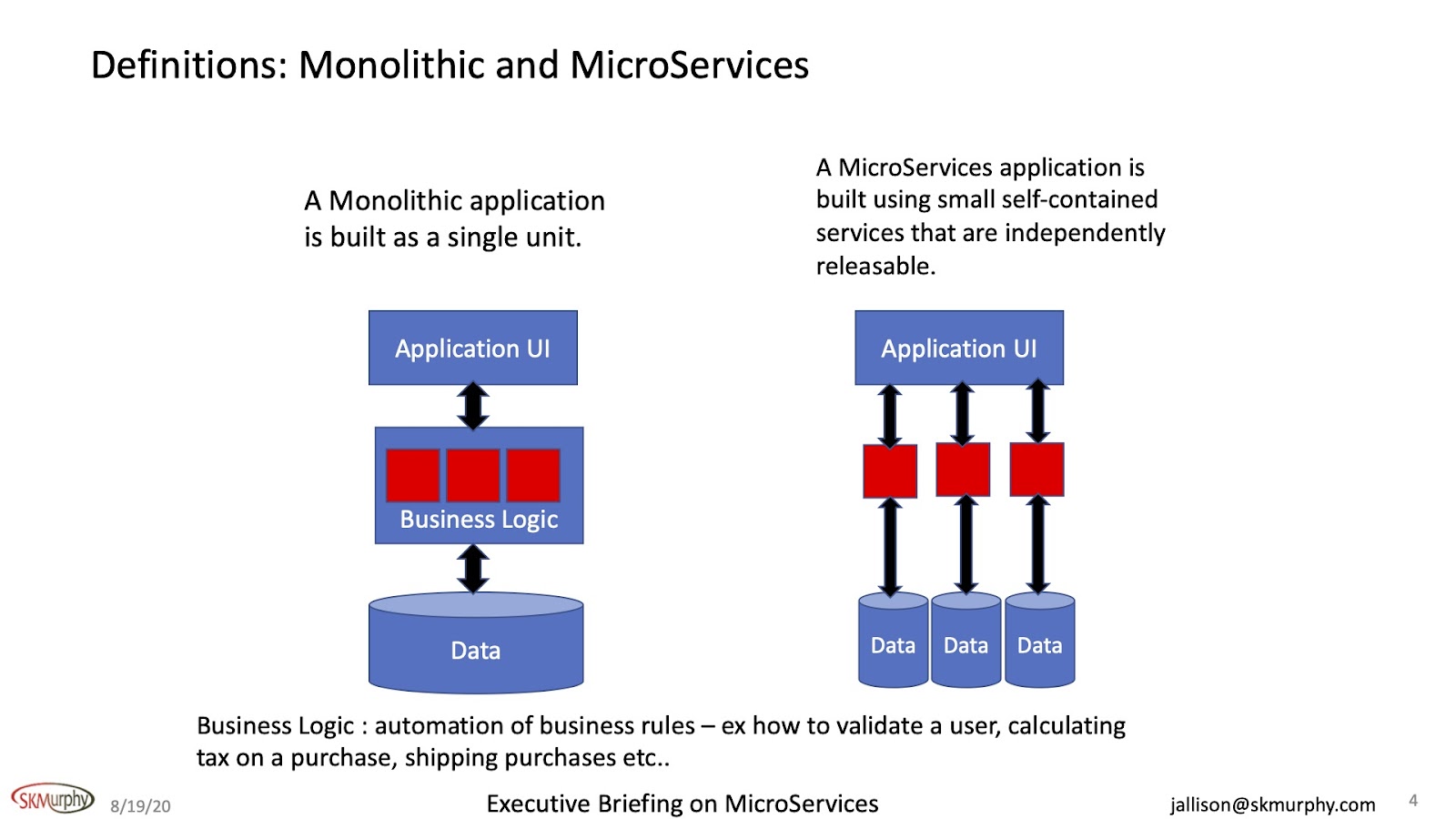


Monolithic applications started through the 1980s to the current day; we are all very familiar with the architecture. A Monolithic application is built as a single unit with a centralized architecture. A MicroServices application is built using small self-contained services that are independently releasable.


A MicroServices application is built very differently. It's made with small self-contained services that, by definition, are independently releasable. But they do the same thing in business logic; they automate business rules, which form a business logic for the applications. And the business rules could be very simple or somewhat complicated. For example, they can validate a user, calculate tax on a purchase, and ship things. So that's my basic definition of MicroService.

Not all Applications need a MicroServices Architecture

Not all applications need a MicroServices architecture. However, sometimes if the complexity doesn't warrant and you try to do a MicroServices architecture, it will probably be more costly than developing a Monolithic application. 


Factors to determine whether you should stay in a Monolithic state or go to the MicroServices architecture include: 


  • Application complexity

  • Size of team <30

  • Business requirements like continuous releases or customer requirements for feature updates


MicroServices only make sense if the complexity of the problem justifies it. Otherwise, they can be more costly than a Monolith.


What is Promised : MicroServices Over Monolithics


  • Speed – fast time to quality and performance

  • Responsiveness – continuous release model

  • Scale – fast turnaround time

  • Cost – smaller teams, scalable tools/test footprint


All executives are measured and bonused on .. contribution to the bottom line and customer satisfaction. 


Improving speed, responsiveness, scale and cost helps meet these corporate objectives.


Responsiveness improves predictability. Being able to just ship a new feature without the customer having to test the whole system. Gives more visibility and predictability into time-to-revenue. Being able to fix a feature without the customer having to regress the whole system improves customer satisfaction.


Executives are always looking to attract and retain top talent. Enabling next generation development methodologies, supporting best in class tools and infrastructure architectures will go a long way to attracting and retaining top talent. 


MicroServices: a lot of Moving Parts

Okay, Why is it difficult? There are a lot of moving parts here, and you have to look at them all. This is what makes it difficult because you will have to put a lot of thought into each of these areas. 
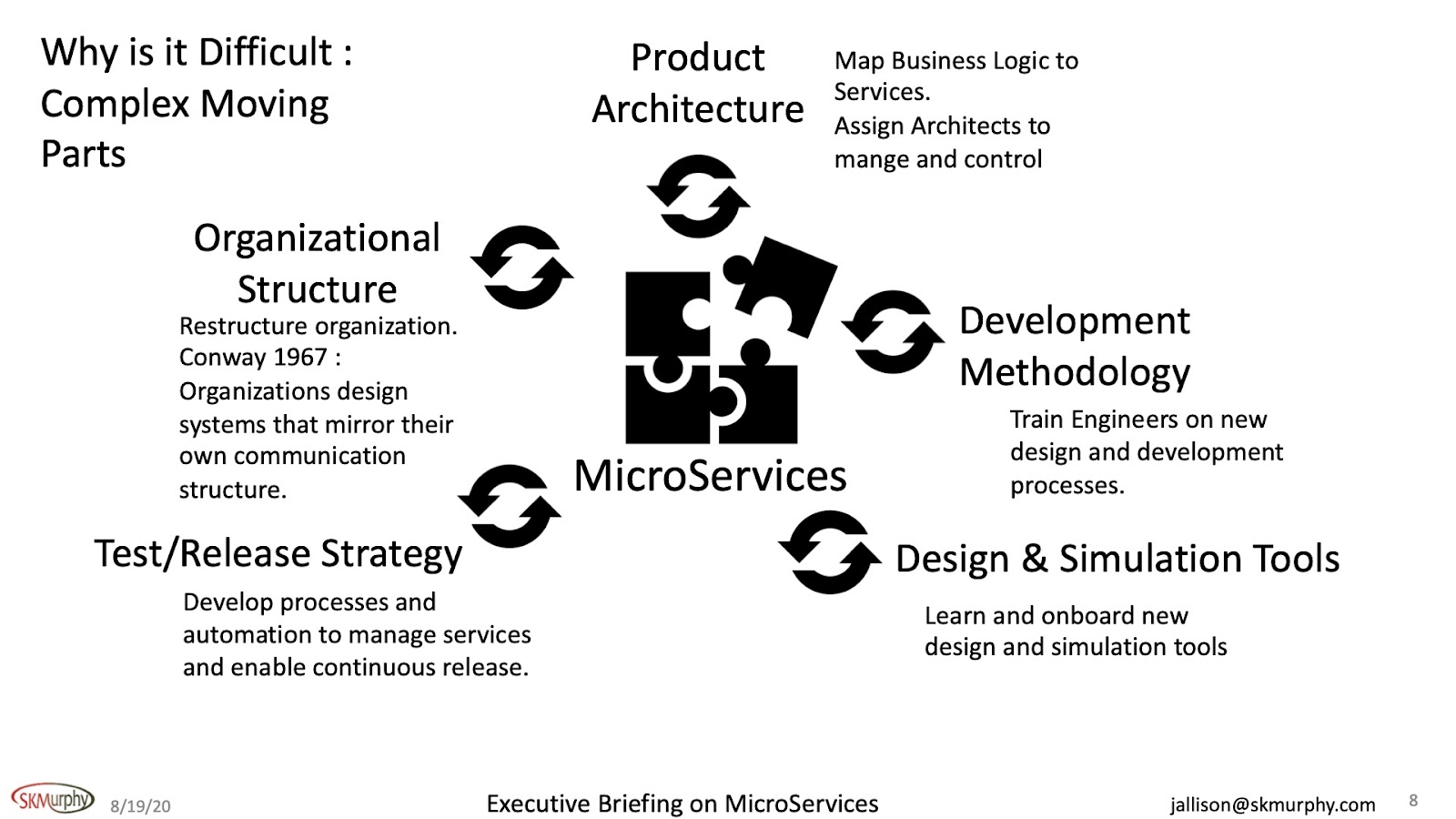

In the product architecture, you need to map business rules to services. For example, the number of services could be in the 100s or even in the 1000s. Due to this scale, you need to assign architects to manage and control the overall architecture of the distributed system. 


It's absolutely critical to establish that process because you just can't have people releasing new services without some levels of control and management. 


You need to figure out how to train people in new design and development processes on the development methodology. This takes time and dollars. Also, someone needs to drive this effort to make sure it happens.


In design and simulation tools, you will have to onboard these tools and get up to speed on how they work and how to use them effectively.


On test and release strategy, it's not a manual process for a distributed system with continuous releases. You can't put this into an Excel spreadsheet, and one person can't get their head around everything that's going on. So it has to be automated.  


Organizational structure is a huge thing. Conway's law says that organizations design systems mirror their communication structure. So, if you've got a decentralized application architecture and a central organizational structure, you've got a problem, and it's hard. Believe me, I've tried to break down higher-level organizations or more central organizations into small and manageable blocks. The inertia there is huge. It's a very tough problem, but you've got to figure out how you manage that if you're going to go this way. 


What we did observe, too, since some companies couldn't do this too well, and they ended up with a distributed monolithic, which causes maybe more problems than they were trying to solve in the first place. 


Key Risks with MicroServices:

  • Focus on security and governance

  • Make sure you have enough telemetry data to diagnose issues in a distributed system

  • Lack of infrastructure and test automation will impact any MicroServices efforts at scale

  • Conway’s law - communication patterns between teams


I wanted to talk about some of the risks. Governance: you need people to manage the introduction of new services to the overall structure. 


Security is, in my mind, a big issue. In a decentralized MicroServices structure, you've got all these services, and they tie together with APIs. Unfortunately, each one of these interfaces is a security issue. So the governance body, or this team of architects, needs to cover their security bases. They need to make sure that they've done everything possible to minimize the impact of any break-in into these structures that causes a security issue.


A decentralized MicroServices structure is massive. In some ways, that's what you want. You want to create an environment where you can very, very quickly introduce new features and functions. Still, you've got to have enough telemetry data to diagnose issues in this distribution system. You can't manually track it. This is not a spreadsheet operation. You need tools to give you visibility into what's happening in this structure.


Lack of infrastructure - if you're not making the right investment and you're not doing the right level of test automation. Any efforts you have to scale MicroServices, they're going to be really, really hard. Do the heavy lifting up front, you'll benefit in the backend, because you've done the hard work. 


Earlier I talked about Conway's law of communication patterns between teams. There's also Amazon’s two-pizza rule for teams. They say that if you can't feed the team on two pizzas, the team's too big and needs to get smaller. In my experience, smaller teams move a lot faster. Also, I'd be seeing decentralized organizations move very, very quickly over more central groups. But I've also seen the challenges in organizing and managing decentralized teams because there are many moving parts, and everyone's moving lightning fast.

Cost & RIO - Monolithic vs. MicroServices

Need to invest up front in people, process and tools to benefit later.
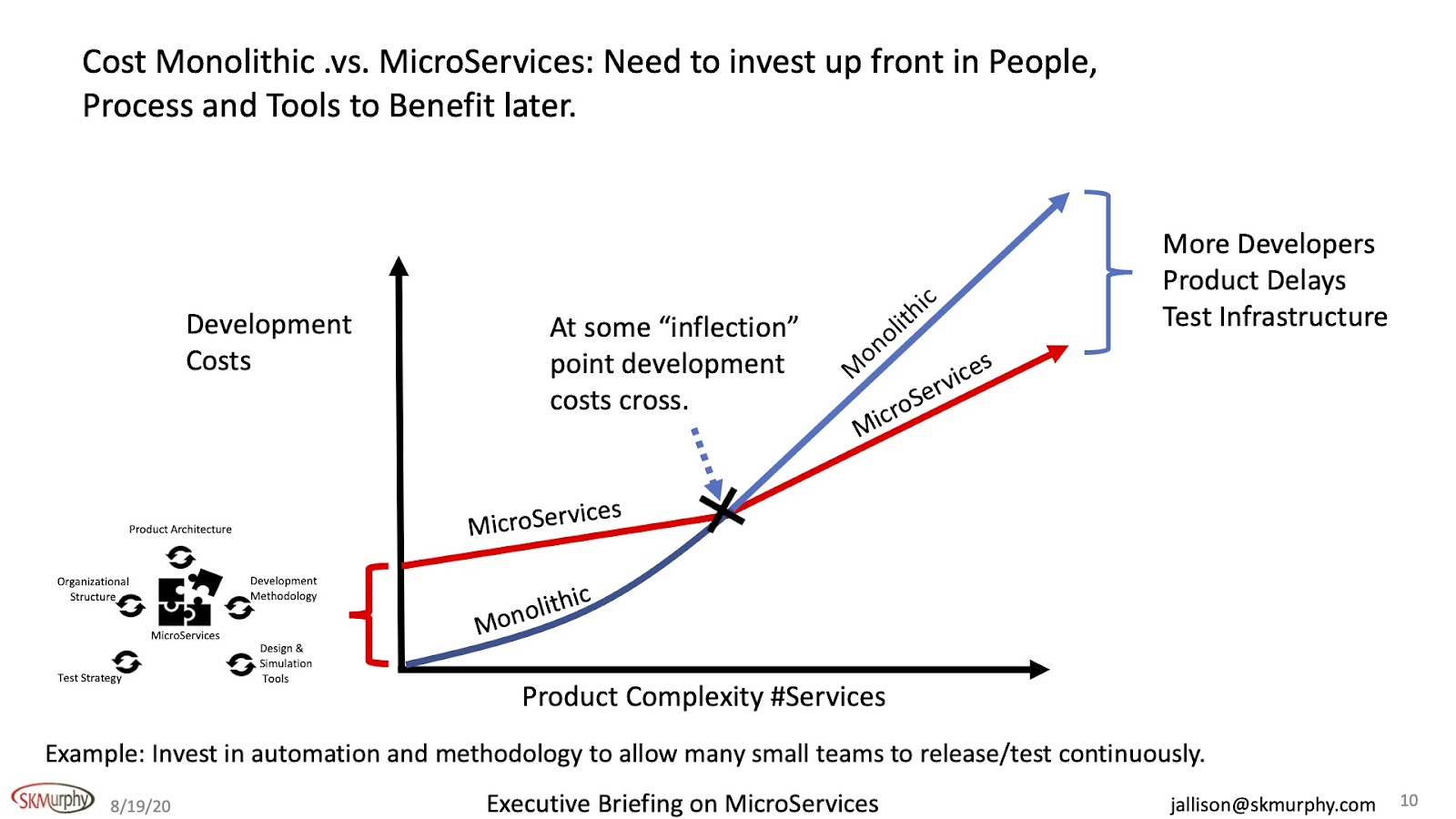

In this chart, I am showing the trade-off here between complexity and development costs. 


Initially, MicroServices cost more than what you are currently doing. This initial cost includes:

  • Training on development methodology

  • New tools 

  • Figuring out the process and strategy

  • Mapping out product architecture and developing structures to protect myself from lots of changes, and rapid growth in my code base.

  • Figuring out the organizational changes


The question is, is there a difference in reliability between Monolithic and MicroServices applications?


I believe so because if you look at it from a test perspective and measure reliability in big Monolithic. When looking at individual components, it's a lot harder to validate the complex interactions internally to that structure. People generally look at the inputs and then just watch the outputs. 


Whereas with a MicroServices architecture, you have full visibility, controllability, and observability between all of those different components. So inherent by definition, the ability to better control and better observe gives you faster time to observe a problem and fix any reliability issue.


Okay, so there are two big takeaways from this diagram. First of all, there are some dollars involved, and they could be significant. And then, we're not going to realize any benefit for some time, and that's always a problem. 


Setting Expectations

You try and get some dollars to do something, and it is significant dollars. And then you say, "Well, you're not going to realize this until down the road," always gets people's attention. So, this is important. And why is it important? Because you need to set the expectations. 


You need to set the expectations correctly upfront to understand that my ROI doesn't happen until somewhere in the future. So you will need to have a plan and a schedule with milestones to communicate the trajectory and what the impact will be to the company over time, and when we're going to start to realize that we're on this trajectory. So the big takeaway here was to set the expectations so that there are no surprises.

Scaling - Monolithic vs. MicroServices
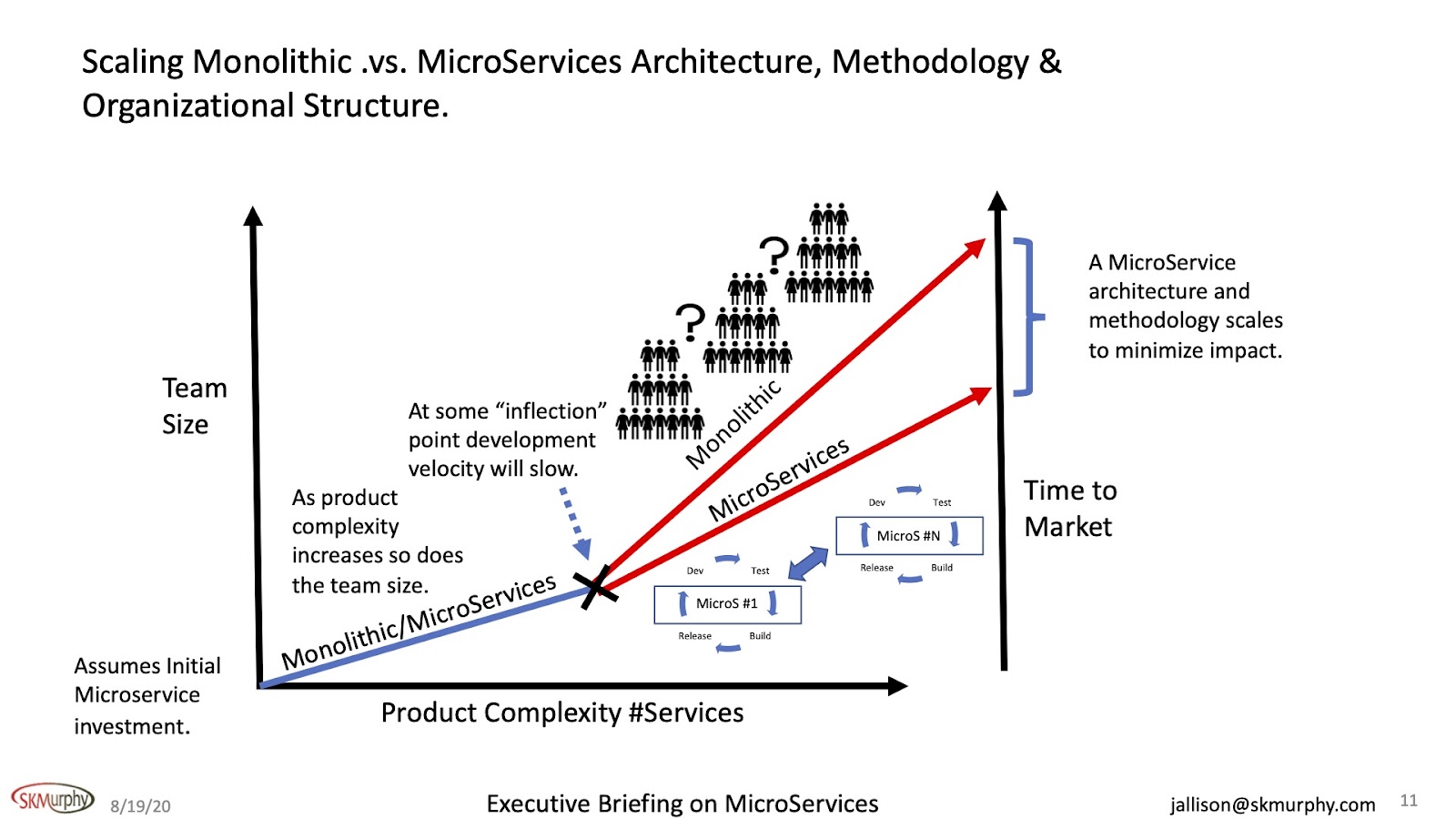


Let’s take another look at cross-reference and team size here with product complexity. I'm assuming here that we've made an initial investment in MicroServices so that I've got a MicroServices methodology going alongside a monolithic development. Initially, they more or less follow the same path. 

I am assuming that as the complexity increases, so does team size. That's not always the case, but happens enough of the time that it is a reasonable assumption. At some point, the development velocity is going to slow. 


In a central structure, as you bring new people on board, they need to understand how the whole thing works. Because individual components may be dependent on each other, everyone on the team needs to understand everything. Many of these systems have been out there for a while.  Documentation does not reflect reality. People that worked on it are no longer there. So these new folks, they become pretty creative. They start to think, "Well, I think it works this way, so therefore, I'll do this, or I'll put a wrapper around it to make it more understandable." Whatever it is they do, the curve for learning goes up. It takes a long time to get their arms around what they're supposed to be doing.

Scaling in a MicroServices Architecture

If done right a microservice architecture protects small teams from unknown or surprise dependencies. They don’t need to know or care about how the whole system works. They only need to understand what business rule or feature they need to code and the input and output of the service they are coding. This allows me to bring on small teams of engineers very quickly and to have an impact very quickly. 


Testing MicroServices Techniques


To change up on you a little bit here, I'm going to talk about testing. To test your software, you need a test strategy. As I said earlier, it's not a manual process. It has to be automated.  


The testing strategy needs to involve both a combination of real resources and virtual resources. 
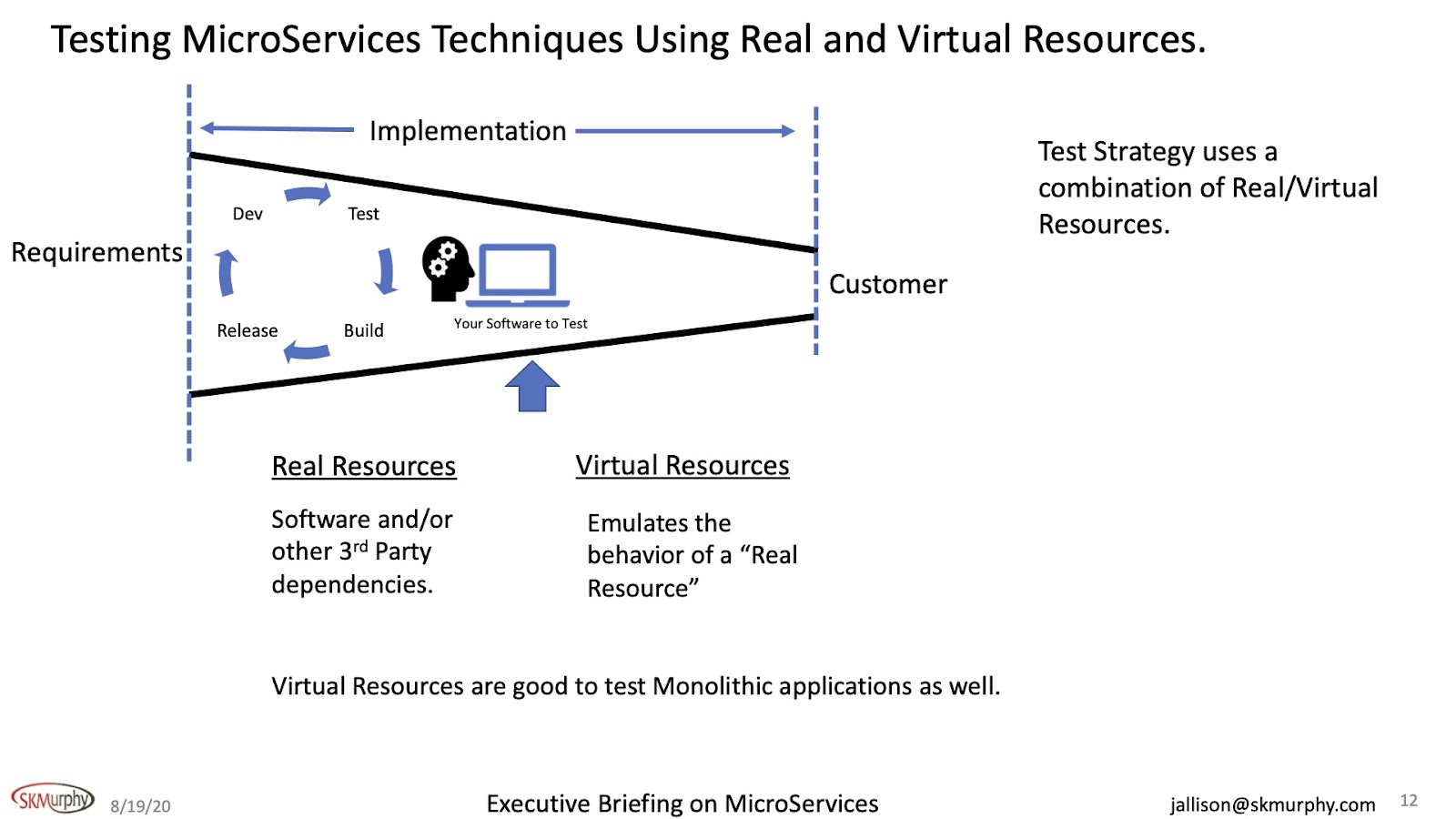


Real resources include:

  • Another software module test and/or production

  • Production/shipping software

  • Hardware dependencies servers etc.

  • 3rd party software (AWS)


Note about real resources: They are difficult to scale as system complexity increases.


Virtual resources include: 

  • Software simulators

  • Service virtualization

  • Test doubles (stubs and mocking)

  • In-memory databases


Virtual resources provide more flexibility to a divide and conquer test approach. Virtual resources provide test capability not possible using real resources. Sometimes the real resources aren't available to you, and what you're going to do? Are you going to wait? No, you've already invested in this decentralized model to make you move fast. Why wait on a resource to test your stuff because it's just going to slow you down.


So you invest in technologies that allow you to emulate the behavior of a real resource because it's not available or hasn't been written yet. This takes work, investment and expertise, but it's critical to continue to develop quickly. Resources like hardware might not always be available. When we were developing some really expensive high-end technology, we had to then go to a 7/24 model and schedule developers’ time on it. As an executive, you just don't want to put anything in front of engineers that's going to slow them down, especially if you can solve it. You just want to take away any barrier and give the right level of resources to an engineer at the right time. It is the only way we can get the throughput that we wanted to realize.


With virtual resources to emulate that the hardware, I can put as many of these as I want in front of any number of engineers that I want. So I'm removing that bottleneck. 


Also with virtual resources, there are some things that you can do that you can't do with a real device. If you had to run against a real device for a certain amount of time before you got to the point where you wanted to test out some new feature, that's a waste of time. If you had a virtual resource, I could just jump straight to that point and then test from there.


It's difficult to scale real resources as the system complexity increases. In a distributed model, you're going to need advanced simulation technology to help you use the methodology for your organization.

Greenfield: Start New Product with MicroServices?

Starting with a MicroService, only makes sense if you've already made the investments in the MicroServices methodology, like all the things that I talked about got a handle on and you've got the abilities to do this.


If you don't, then you should start with a monolithic and then plan to go to a MicroServices architecture later. So the nice thing I like about this approach is you can use this monolithic and you can probably get out there much faster. You can use it as a fast prototype. So you could be out there with this monolithic thing and you could be making lots of iterations, understanding what people are doing with it, how they're using it, come back, modify it, come back, modify it and start looking at your dials: application complexity, size of team and business requirements.


Move to MicroServices when you have crossed the complexity boundary. When managing a monolithic application is going to slow you down. 


The only problem with this is it's too serial. I mean, what you need to be able to do is you need to say, "Okay, I'm running along here with my fast prototype, this monolithic. I imagine maybe at some point I need to change to more of a MicroServices. Let me measure along the way and predict. I can start a parallel MicroServices architecture. 


I've got a Monolithic app and I can go to the MicroServices app. Microservices app is not ready for prime time, yet I'm working on itl. When I get to this point that I'm measuring, I'm using some indicators here, I just cut over.


I think that's the way in which you should use that. Get out there quickly, get some feedback, understand it's going to go that route, start working in parallel and then cut over. There's no disruption to your store base. Then you're off and running and utilizing all the benefits you get from this architecture. The issue here is parallel. That's always dollars, more people.


Wrap Strategy
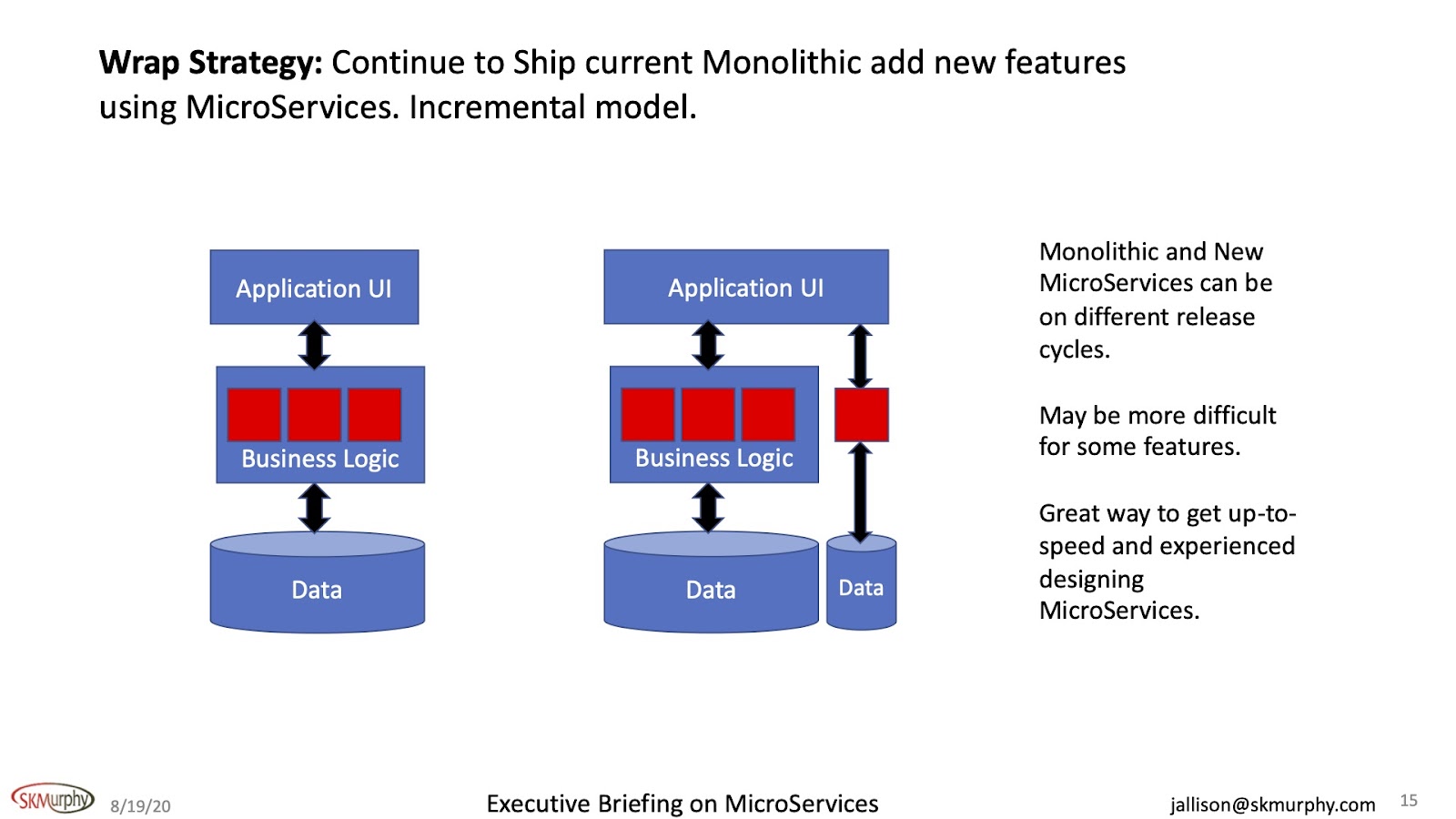

Another way to get started is to continue to ship the current model. You've got this thing, it works, ship it. Anything new, make a MicroServices. Now, this may be more difficult for some features, I'm absolutely sure of it. But conceptually, if you can do this it makes customer acceptance of this new feature much simpler, faster and cheaper because they only need to test the new feature. If this feature was released in the monolithic they would have to regress the whole system.


These features could be on a different release cycle. The monolithic could be on a 3, 6, 9 months cycle. Whatever makes sense. The release cycle of the new feature could be every day. And this is a great way to get started. 
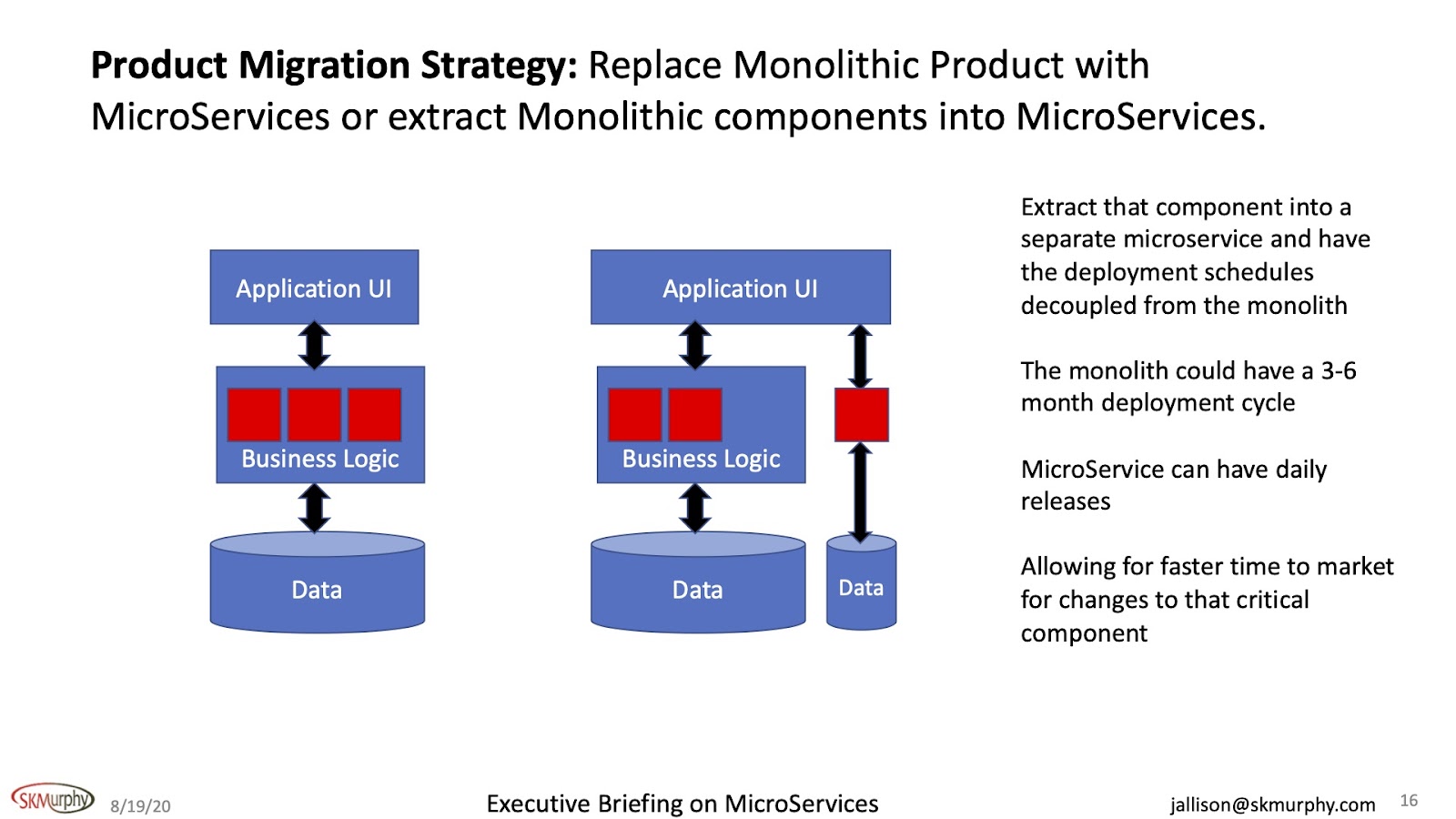


Along the same lines, instead of adding something new, pull something out. So, I've always had a problem with this function. This component has causes a lot of problems and I need to change it often. Why don't I just pull it out of here and then all this stuff that I don't need to change often, stays where it is.


This problematic component is coded and developed and shipped with a MicroServices methodology. It just works for me again. The other components are on different release cycles and the MicroServices component is daily with supports for quick revs. 


Test Migration Strategy


Let’s talk about a test migration strategy to use virtual services for monothitlics. Everything I have talked about with microservices architectures, for testing and virtual resources can be applied to monolithics too. Say my current test environment requires a production database or a live 3rd party resource. These may be difficult and expensive to schedule and utilize. I could emulate that database or 3rd party service using a virtual resource. What I talked about simulation for microservices also works for monolithics.

Key Points and Takeaways

  • Not all applications need to be MicroService.

  • Many ways to start :

    • Monolithic first then MicroService

    • Add new Features as MicroService to Monolithic

    • Replace components of a Monolithic with a MicroService

  • Need to invest in people, tools and process

    • Hire expertise

    • Training

    • New tools and infrastructure

    • Structure of Organization

  • Need to plan carefully and set expectations internally 

    • Budget

    • ROI


This was an edited transcript of Jeff Allison’s talk to the SF Bay ACM Meetup on Wed-Aug-19.